
Example: concrete slab
A 12 ft × 10 ft patio poured 4 inches (⅓ ft) deep is 12 × 10 × ⅓ = 40 cubic feet. Divided by 27 that is 1.48 cubic yards, or about 67 bags of 80 lb concrete before waste.

Cubic Yard Calculator
Version 1.0 · Android & iOS
Enter length, width and depth in feet, inches, yards, metres or centimetres. Get cubic yards for concrete, gravel, mulch or topsoil with an optional waste allowance.

Get the app
Cubic Yard Calculator
Available now on iOS and Android
Estimates are a planning aid. Confirm quantities with your supplier before ordering.
The example is 12 ft × 10 ft × 4 in. Choose Calculate to include the selected waste allowance.
Free core calculator
Every shape, every unit, unlimited
14 material presets
Cubic yards plus estimated tons
Works offline
No account, no cloud storage
Cubic yard guide
Measure the length, width and depth, convert each to feet (divide inches by 12), multiply them together for cubic feet, then divide by 27. That works for concrete, gravel, dirt, mulch and sand alike: length × width × depth ÷ 27 = cubic yards.
A 12 ft × 10 ft patio poured 4 inches (⅓ ft) deep is 12 × 10 × ⅓ = 40 cubic feet. Divided by 27 that is 1.48 cubic yards, or about 67 bags of 80 lb concrete before waste.
A 20 ft × 10 ft garden bed filled 6 inches deep is 20 × 10 × 0.5 = 100 cubic feet. Divided by 27 that is 3.70 cubic yards of soil.
| Bag size | Typical yield | Bags per yd³ |
|---|---|---|
| 80 lb | 0.60 ft³ | 45 |
| 60 lb | 0.45 ft³ | 60 |
| 40 lb | 0.30 ft³ | 90 |
Yields vary by brand and mix. Check the bag label, then add your waste allowance.
| Depth | Area covered by 1 yd³ |
|---|---|
| 2 in | 162 sq ft |
| 3 in | 108 sq ft |
| 4 in | 81 sq ft |
| 6 in | 54 sq ft |
Useful for mulch, gravel and topsoil beds. Divide your area by the figure to get cubic yards.
Reference tables
One cubic yard is a cube 3 feet on each side: 27 cubic feet, about three-quarters of a cubic meter, or roughly 202 US gallons. Use these tables to picture an order, convert it, and estimate the tons a supplier will quote.
| Cubic yards | Cubic feet | Cubic meters | US gallons | Covers at 4 in deep |
|---|---|---|---|---|
| 1 yd³ | 27 ft³ | 0.76 m³ | 202 gal | 81 sq ft |
| 2 yd³ | 54 ft³ | 1.53 m³ | 404 gal | 162 sq ft |
| 5 yd³ | 135 ft³ | 3.82 m³ | 1,010 gal | 405 sq ft |
| 10 yd³ | 270 ft³ | 7.65 m³ | 2,020 gal | 810 sq ft |
| 12 yd³ | 324 ft³ | 9.17 m³ | 2,424 gal | 972 sq ft |
| 15 yd³ | 405 ft³ | 11.47 m³ | 3,030 gal | 1,215 sq ft |
| 20 yd³ | 540 ft³ | 15.29 m³ | 4,039 gal | 1,620 sq ft |
| 50 yd³ | 1,350 ft³ | 38.23 m³ | 10,099 gal | 4,050 sq ft |
| Material | lb per yd³ | Tons per yd³ |
|---|---|---|
| Concrete | 4,050 | 2.02 |
| Gravel | 2,835 | 1.42 |
| Crushed stone | 2,700 | 1.35 |
| Sand | 2,700 | 1.35 |
| Topsoil | 2,000 | 1.00 |
| Fill dirt | 2,200 | 1.10 |
| Mulch | 800 | 0.40 |
Typical weights in US short tons. Wet, compacted or crushed material can weigh more.
| Area and depth | Cubic yards | 80 lb bags | Tons of gravel |
|---|---|---|---|
| 10 × 10 ft, 4 in deep | 1.23 | 56 | 1.8 |
| 12 × 12 ft, 4 in deep | 1.78 | 80 | 2.5 |
| 10 × 20 ft, 4 in deep | 2.47 | 112 | 3.5 |
| 20 × 20 ft, 4 in deep | 4.94 | 223 | 7.0 |
| 24 × 24 ft, 4 in deep | 7.11 | 320 | 10.1 |
| 10 × 20 ft, 6 in deep | 3.70 | 167 | 5.3 |
Before waste. Add 5 to 10% for concrete and gravel.
Built for the job site
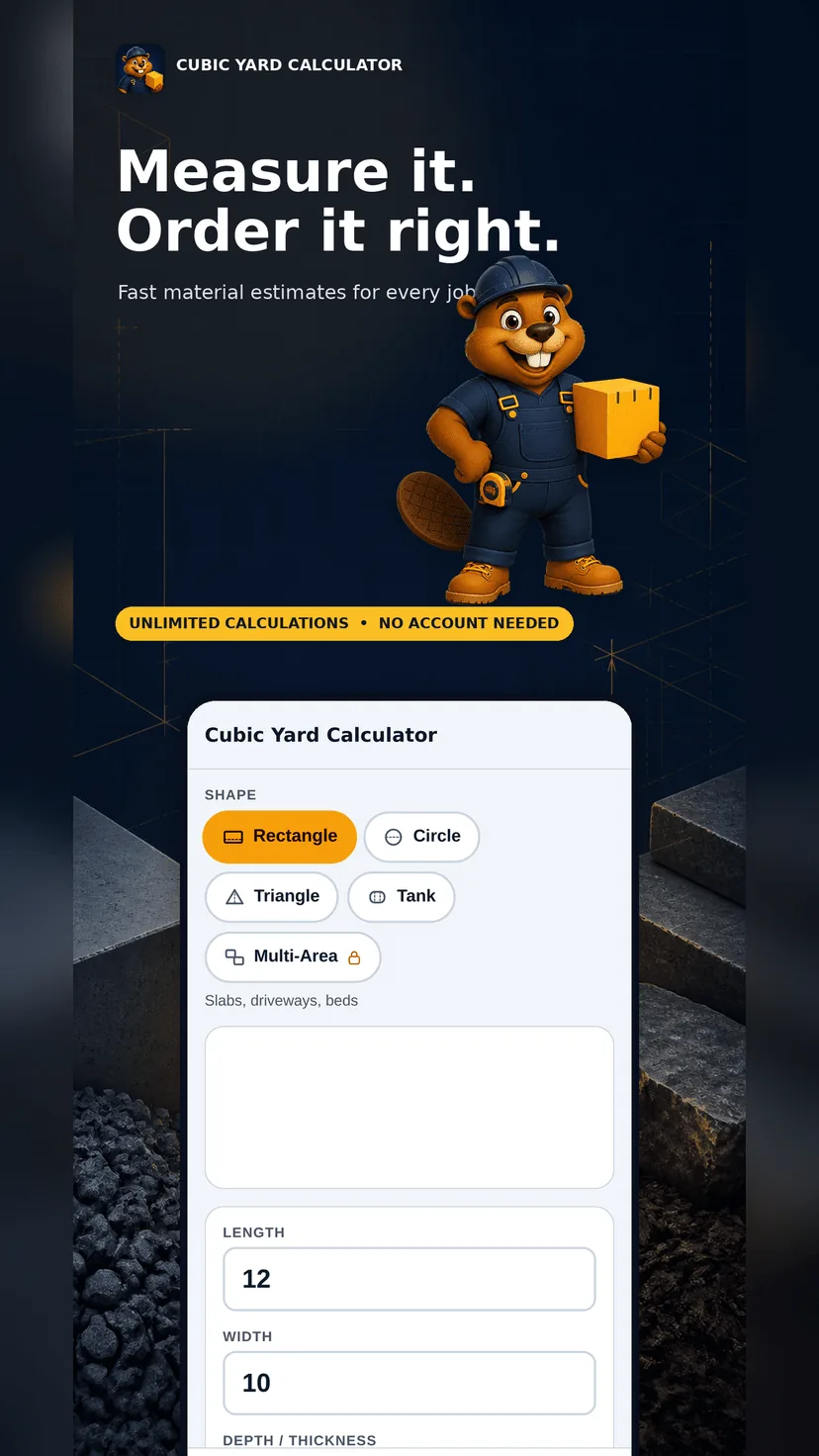
Rectangle or slab, round holes and footings, and wedge-shaped corners, the three shapes most job-site measurements actually reduce to.
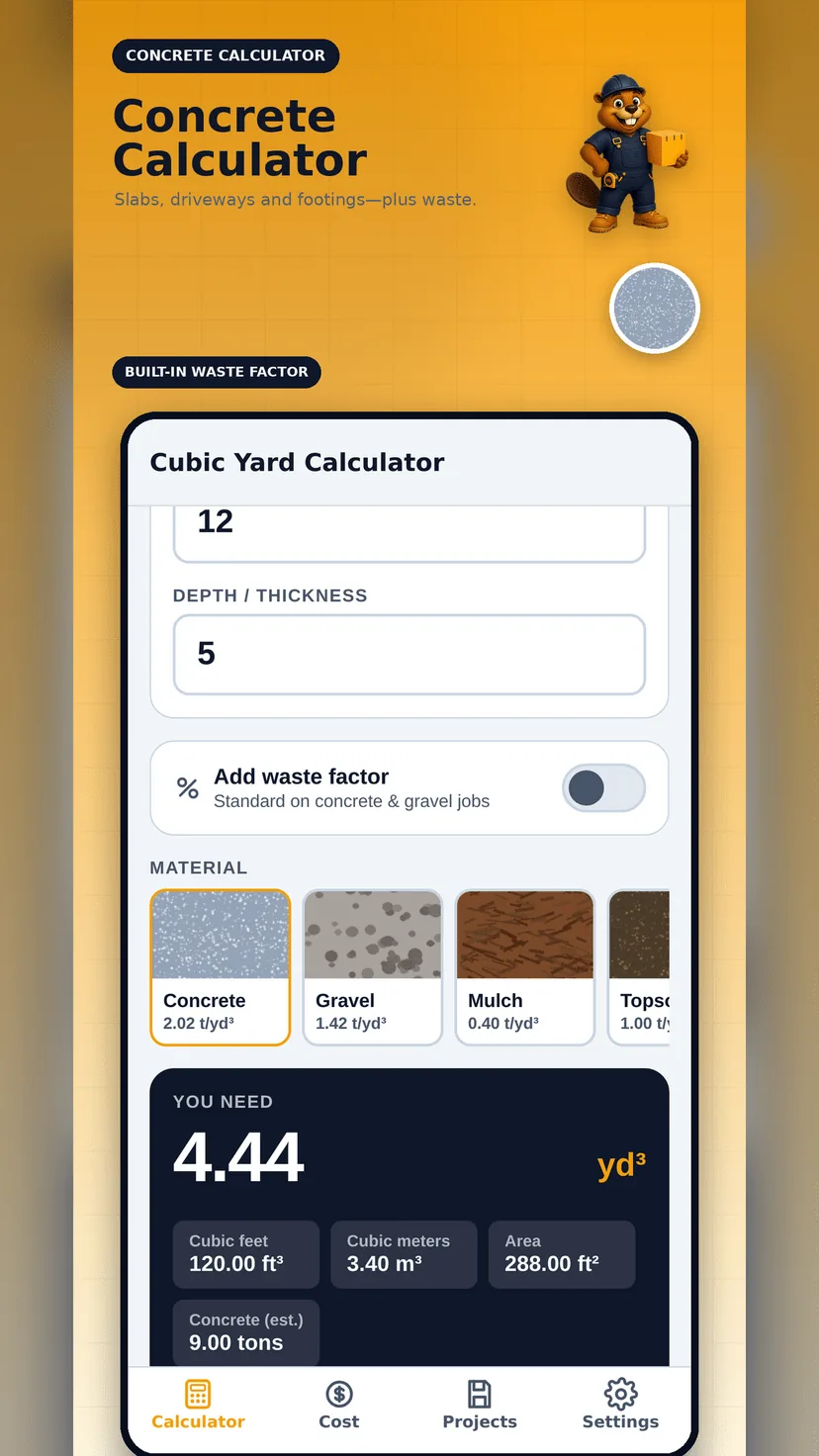
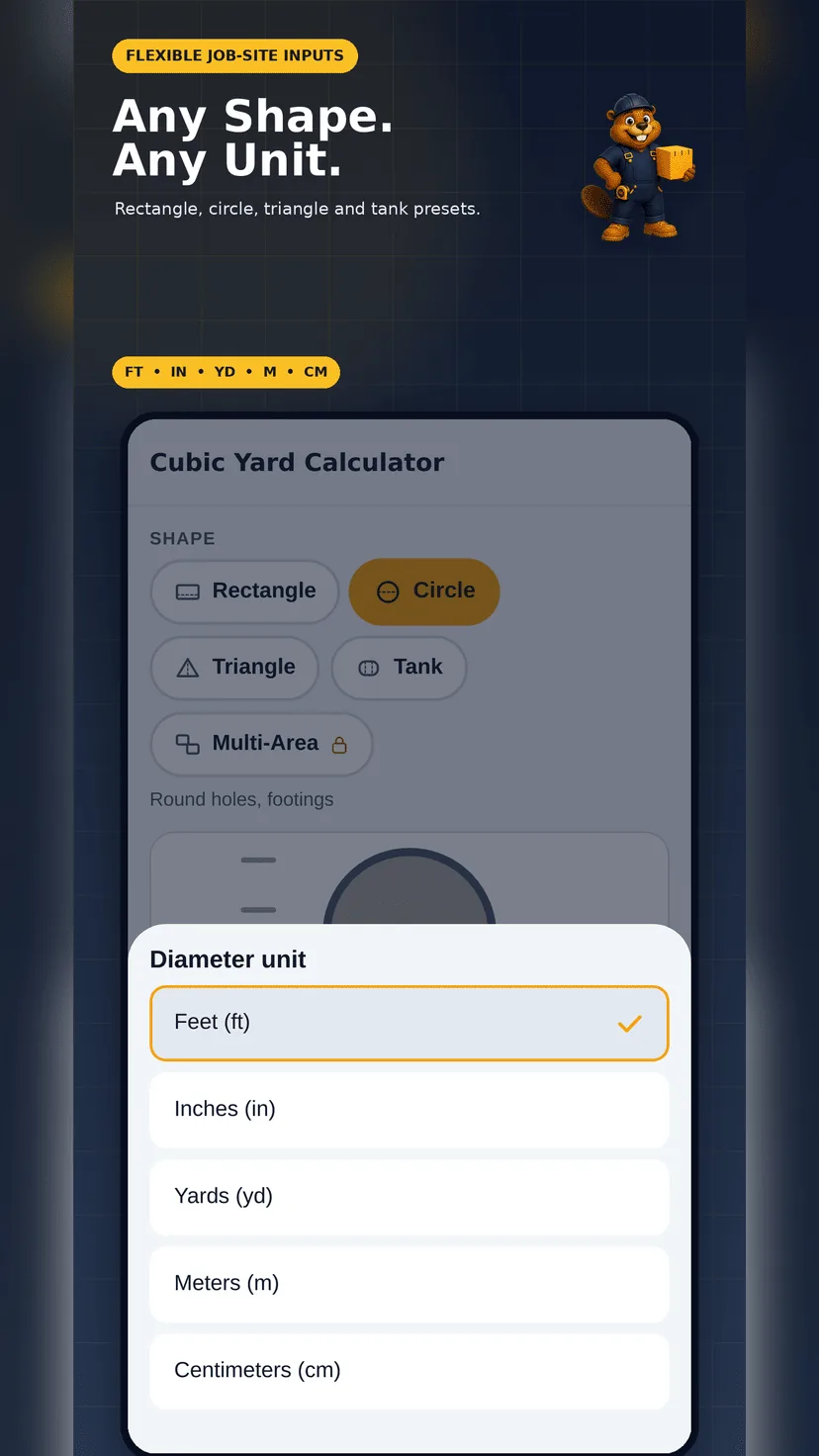
Feet, inches, yards, meters and centimeters on every input. Enter 12 ft × 10 ft × 4 in and read cubic yards, cubic feet and cubic meters together.
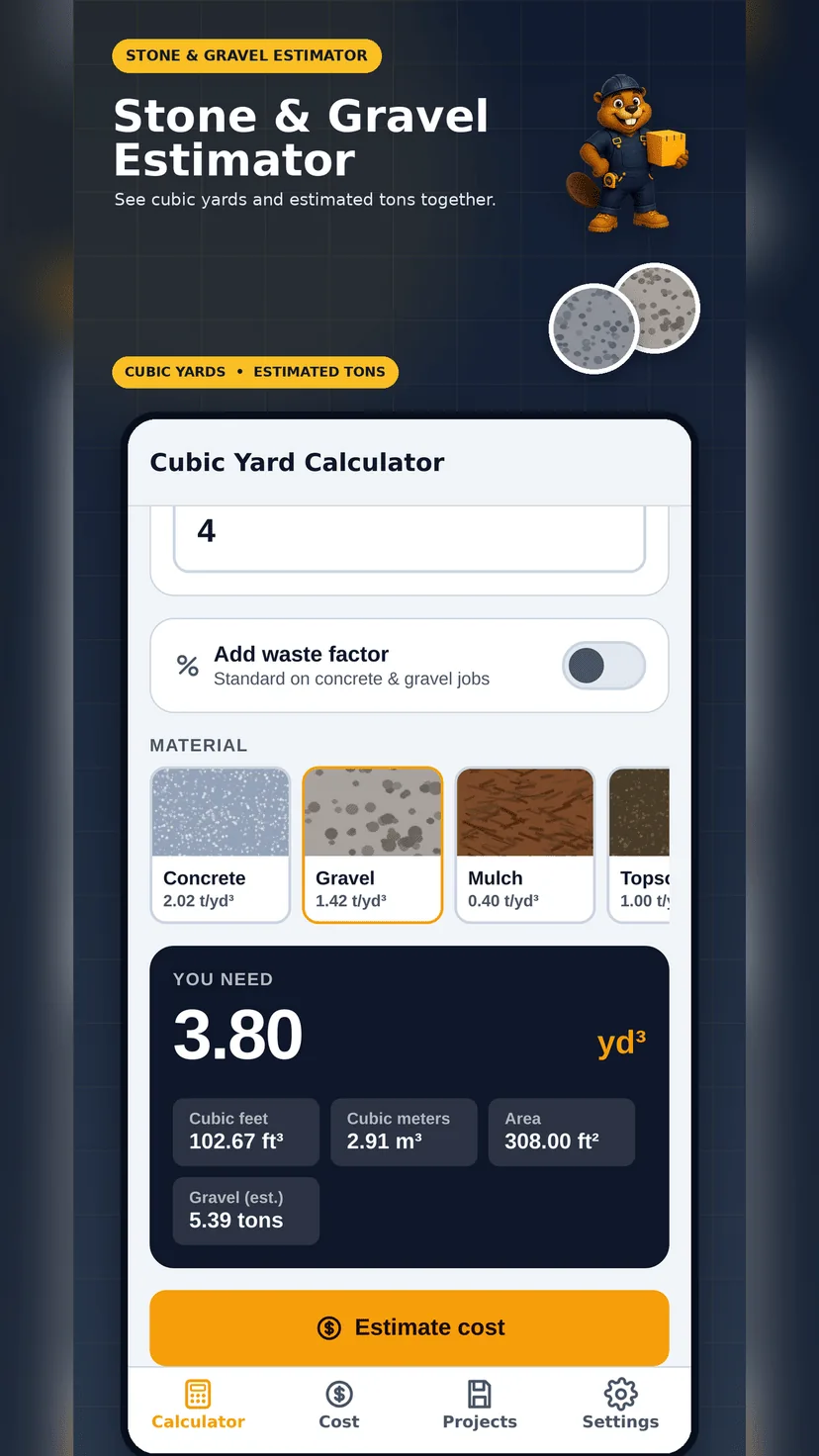
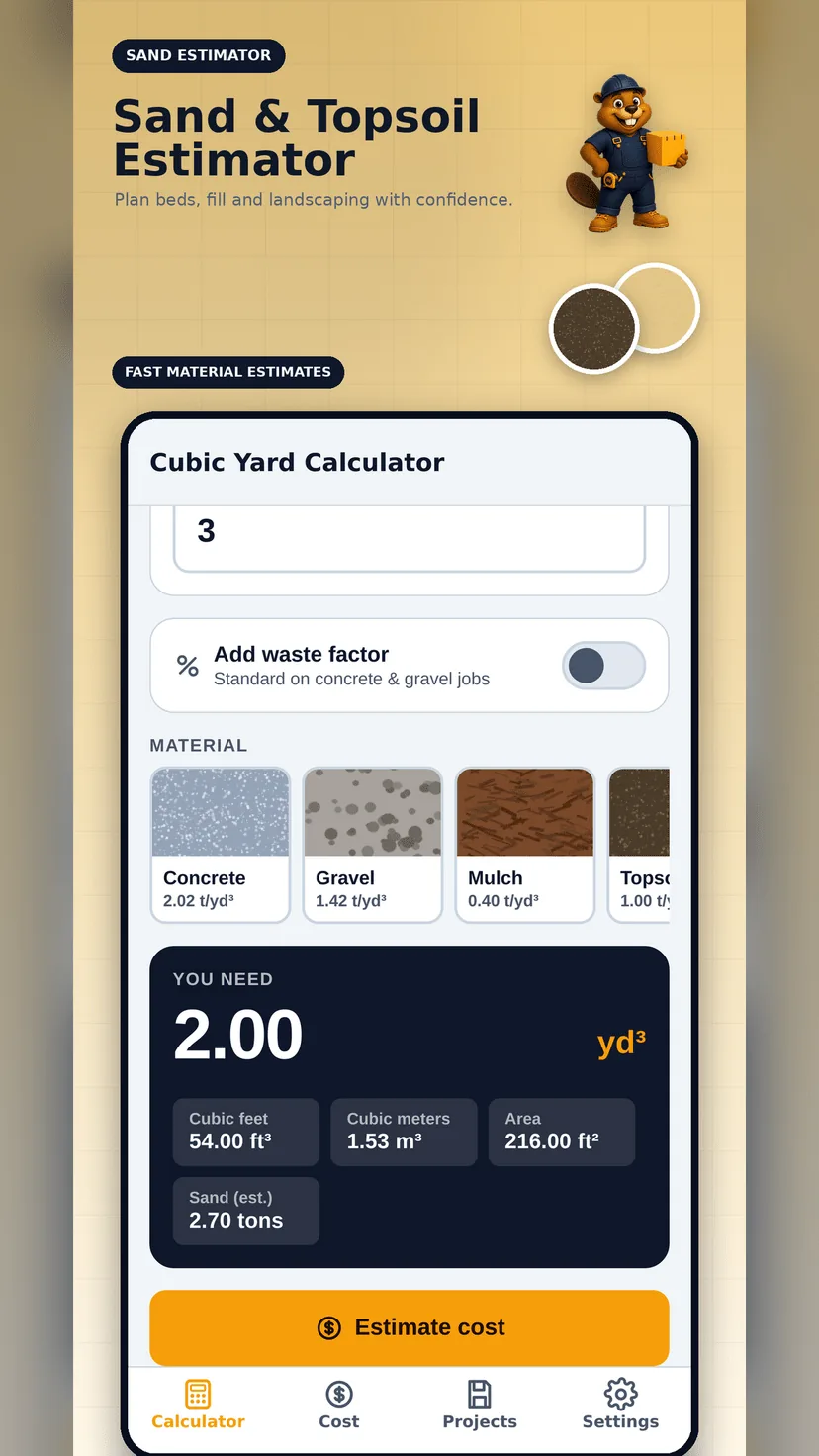
Fourteen presets covering concrete, gravel, crushed stone, pea gravel, river rock, limestone, mulch, topsoil, sand and fill dirt, each with typical supplier densities.
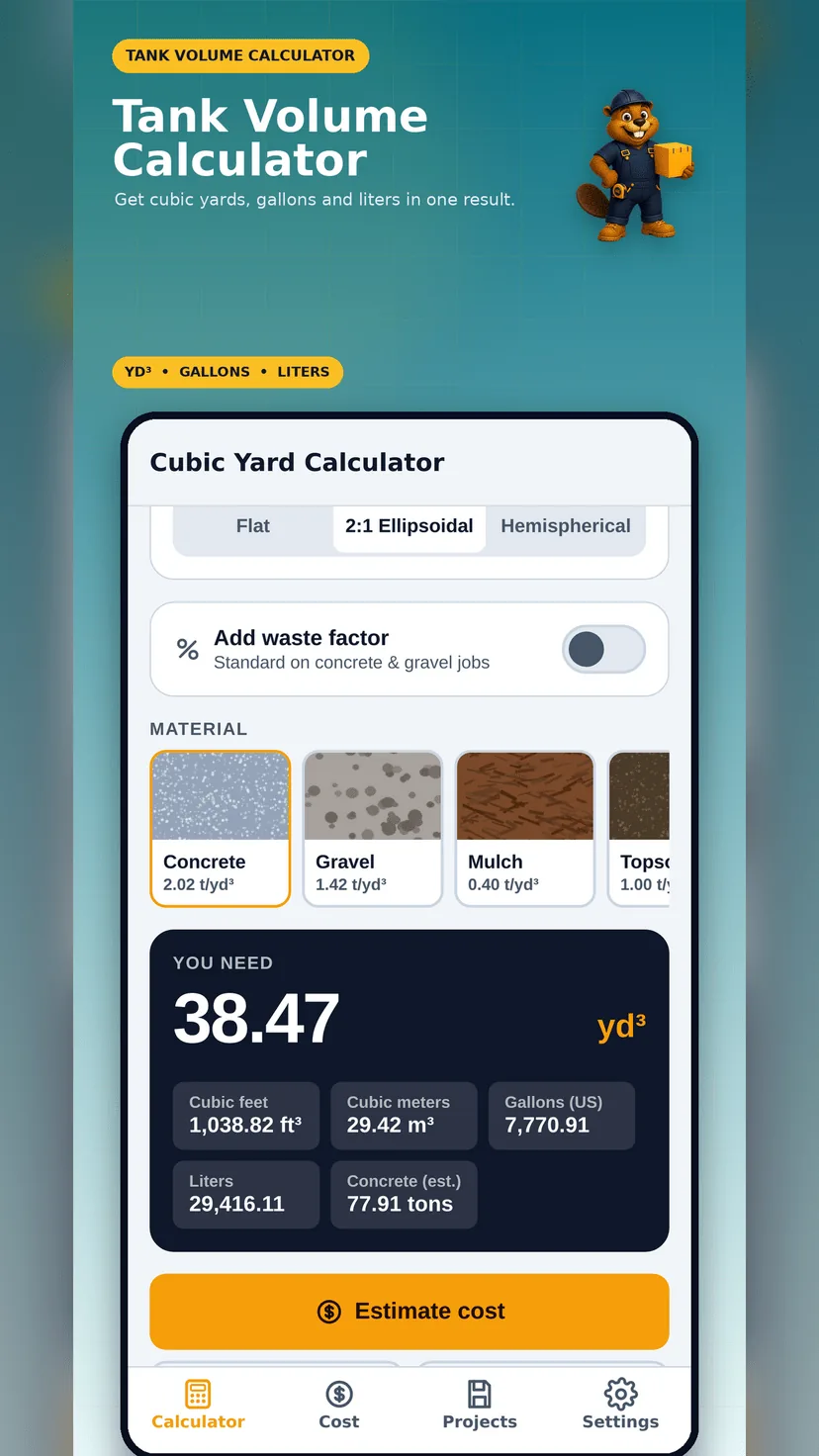
Cylindrical and ellipsoidal tanks reported in gallons and liters alongside cubic yards, for the volume questions a slab calculator cannot answer.
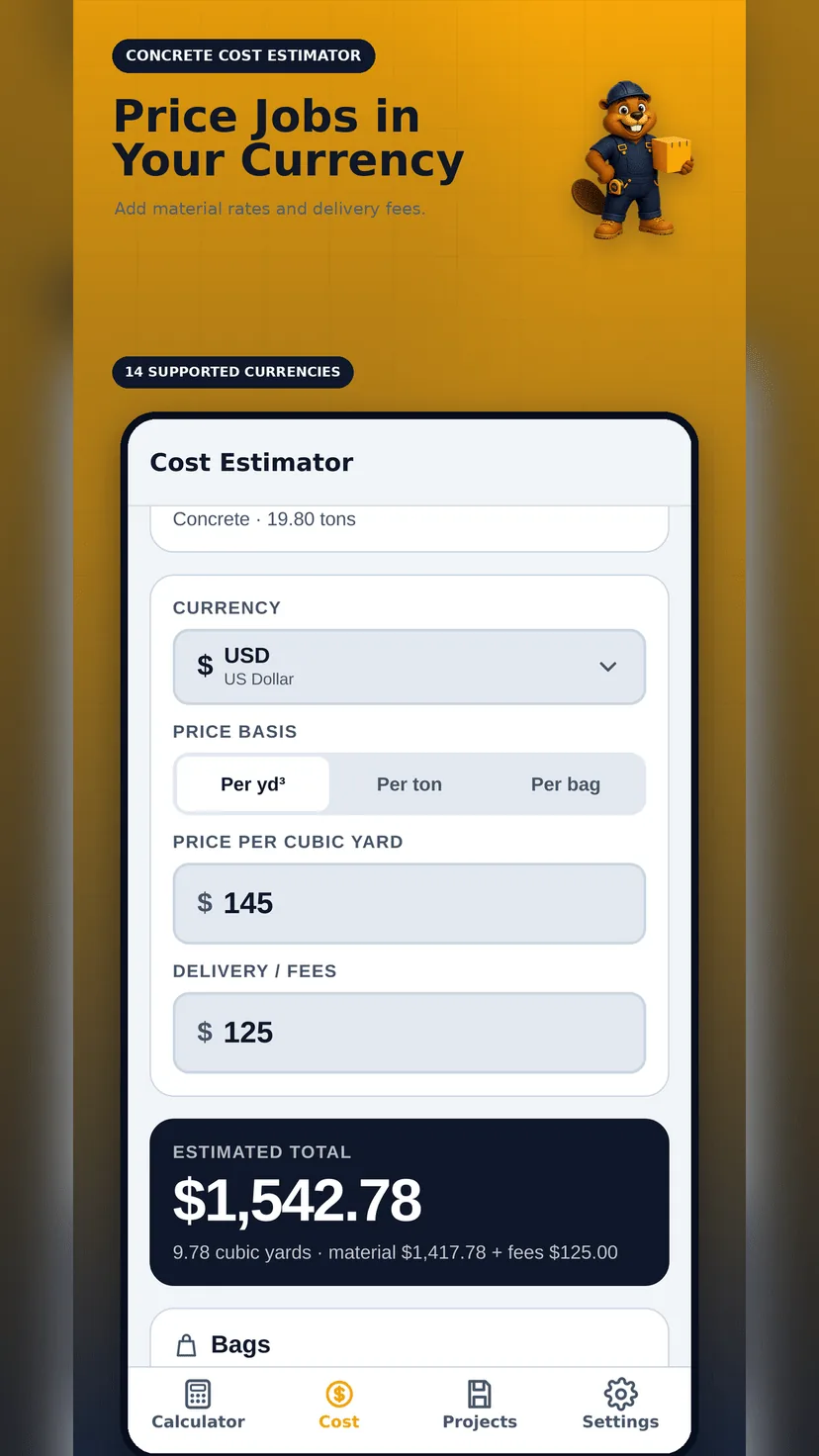
Price per cubic yard, per ton or per bag, plus delivery fees, to turn a volume into a number you can quote. Pro.
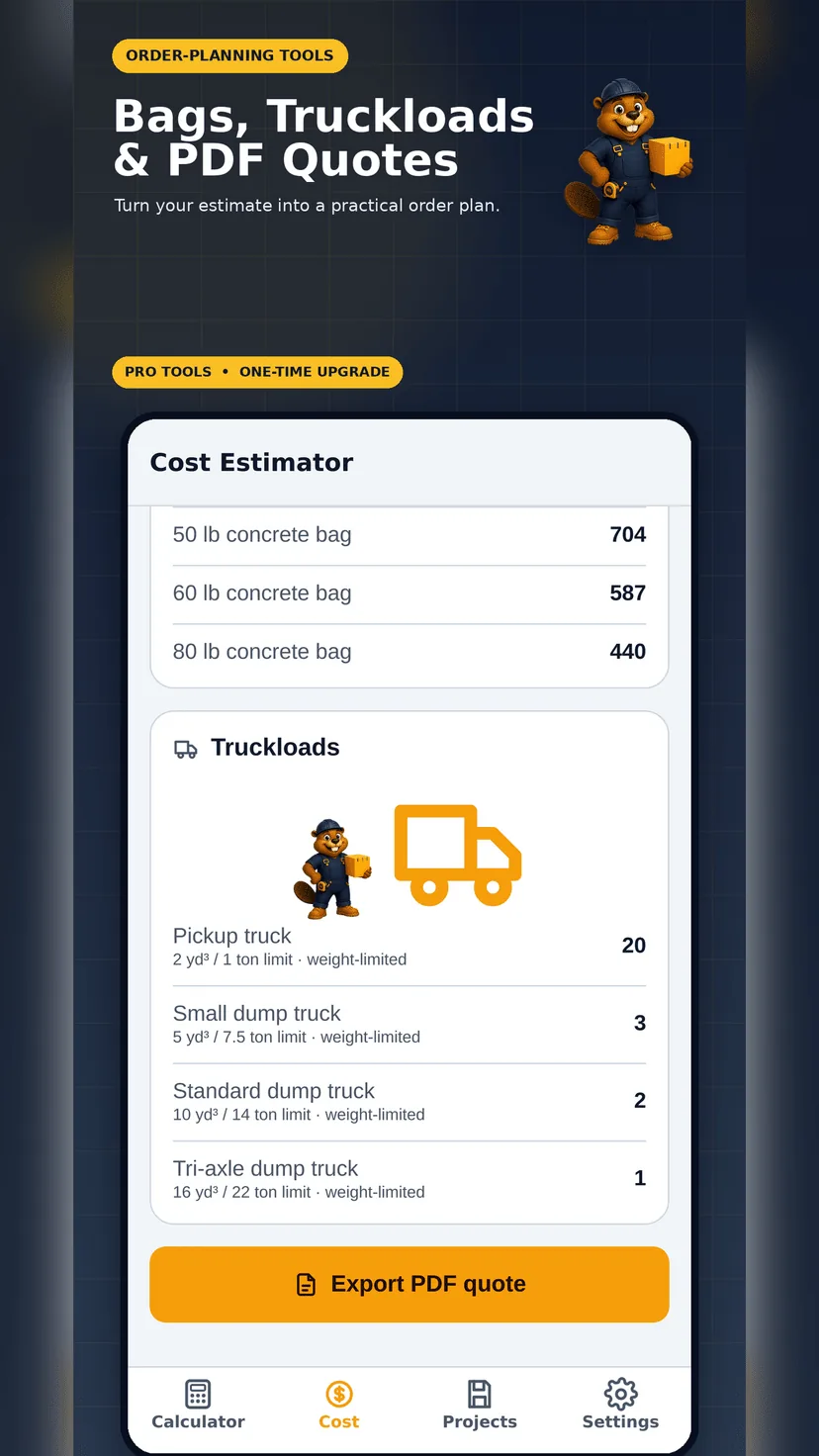
40, 50, 60 and 80 lb bag counts, pickup and dump-truck loads by weight and volume, and a PDF material quote to send a client. Pro.
Inside version 1.0
Swipe on a phone or browse the full gallery on a larger screen.
How the math works
Contractors notice wrong math, so the volume engine is small, pure and unit-tested. Dimensions are normalized to feet, area comes from the selected shape, depth turns it into cubic feet, and the yardage is that figure over 27, with cubic feet and cubic meters printed beside it so the answer can be checked at a glance.
Rectangle or slab, circle, triangle or tank, then enter the dimensions in whatever units you measured.
The preset density converts your volume into an estimated tonnage for the supplier.
Apply a 5 to 20% waste factor, then price the order per cubic yard, per ton or per bag.
There is no account, no sign-up and no server. Measurements, saved projects and the prices you charge stay in local storage on the device and are removed when you uninstall the app.
Free, then optional
Every shape, unit conversion, material preset and waste calculation is free and unlimited, and no calculation is gated behind an ad. The free version carries a banner and an occasional, frequency-capped full-screen ad. A single $3.99 purchase removes advertising and unlocks saved projects, cost estimation, bag and truckload conversions, multi-area sites and PDF quotes. It is not a subscription.
Convert every dimension to feet, compute the area for the shape, multiply by depth for a volume in cubic feet, then divide by 27, because one cubic yard is 27 cubic feet. The calculator and the app show cubic feet and cubic meters next to the yardage so the conversion can be checked.
About 45 bags of 80 lb premix, 60 bags of 60 lb or 90 bags of 40 lb, based on typical yields of 0.60, 0.45 and 0.30 cubic feet per bag. Add your waste allowance on top, and check the yield printed on the bag you buy.
Measure length, width and depth, convert inches to feet by dividing by 12, multiply them for cubic feet and divide by 27. A 20 ft × 10 ft bed filled 6 inches deep is 100 cubic feet, or 3.70 cubic yards. Fill dirt and topsoil settle once spread and compacted, so many people order extra.
Ten cubic yards is 270 cubic feet or 7.65 cubic meters, about the size of a box 10 ft long, 9 ft wide and 3 ft high. Spread 4 inches deep it covers 810 square feet, and 10 cubic yards of gravel weighs roughly 14 tons.
A cubic yard of gravel typically weighs about 1.4 tons (2,835 lb), topsoil about 1.0 tons and mulch only around 0.4 tons. Multiply your cubic yards by the figure for your material, and ask the supplier for theirs, because moisture and compaction change it.
Divide cubic feet by 27, because a cubic yard is 3 ft × 3 ft × 3 ft. For example, 81 cubic feet of gravel is 81 ÷ 27 = 3 cubic yards. To go the other way, multiply cubic yards by 27.
Weight is usually the limit, not volume. A full-size pickup bed holds roughly 2 to 3 cubic yards level, which suits light mulch, but one cubic yard of gravel or wet topsoil can weigh well over a ton, more than many half-ton pickups are rated to carry. Standard tandem dump trucks commonly haul about 10 to 14 cubic yards. Check your payload rating and ask the supplier how much they load per trip.
Yes. Every shape except multi-area, all unit conversions, all cubic yard, cubic feet and cubic meter output, the waste factor and the material presets are free and unlimited. No calculation is ever locked behind an ad or a video.
Pro is a one-time $3.99 purchase, not a subscription. It removes all advertising and adds saved projects, the cost estimator, bag and truckload conversions, multi-area calculations for irregular sites, extra material presets and PDF quote export.
Yes. Choose a material and the result includes an estimated tonnage using a typical supplier density. Densities vary by supplier, moisture and compaction, so confirm the figure with your yard before ordering.
Yes. All calculations run on the device. There is no account, no sign-up and no server. Measurements, saved projects and prices stay on your phone and are deleted when the app is uninstalled.
Concrete and gravel jobs routinely need more material than the raw geometry suggests, because of spillage, uneven subgrade and over-excavation. One tap applies a 5%, 10%, 15% or 20% allowance to the order quantity.
Out now on iOS and Android. Questions about a calculation or a purchase go straight to app support.